
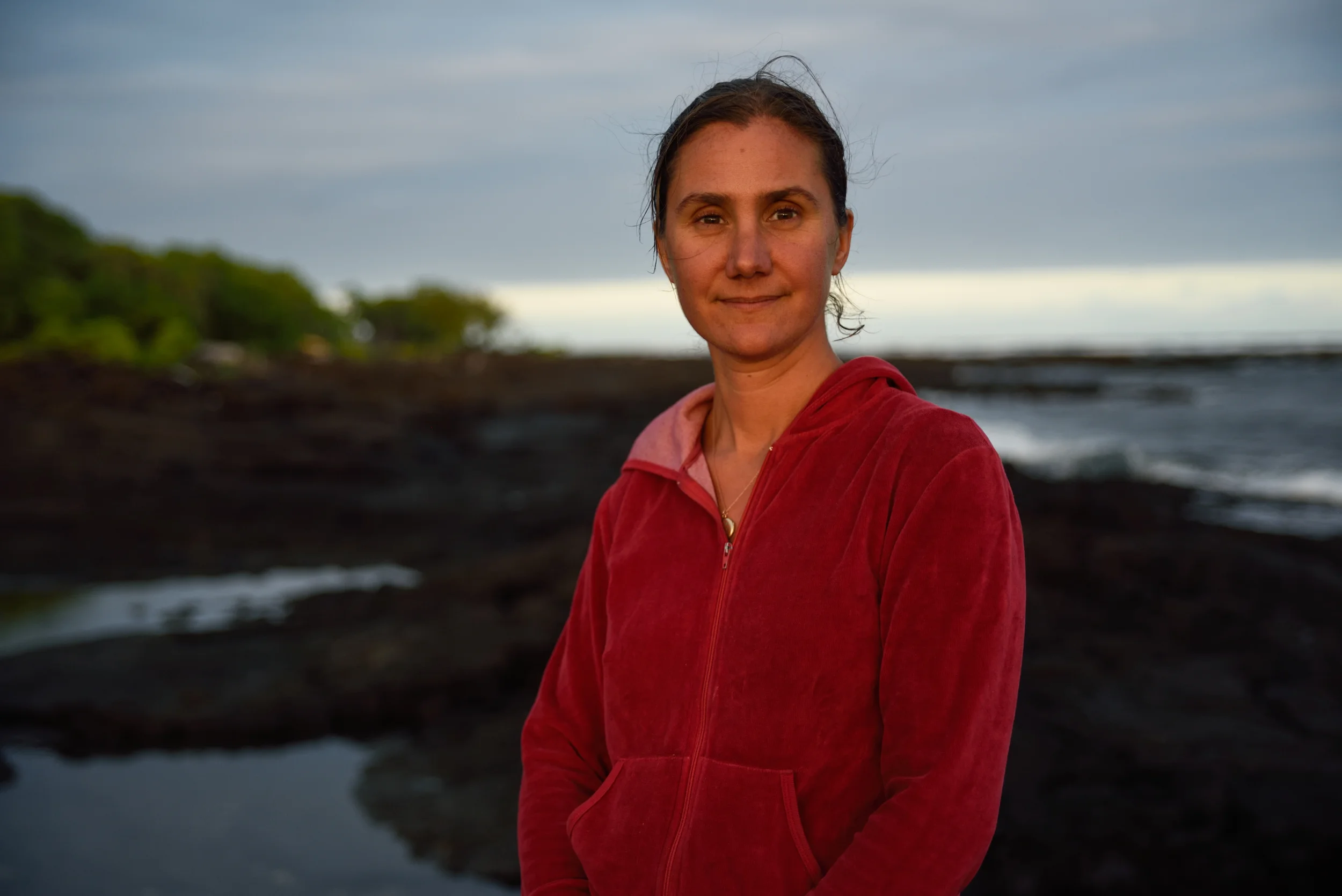
Photo by Clementine Wilson, Hawaii 2016
About DARCY
Darcy Ottey (she/they) is a facilitator, educator, researcher, and ritual practitioner. The descendant of Quaker settlers, British coalminers, and Ukrainian peasants, land-based cultural practices have been part of Darcy’s life since her youth. Through projects including Re-Calling Our Ancestors, Nourishing Futures, and Rites and Responsibilities, Darcy devotes her life energy to deconstructing dominant pathways into and through adulthood and offering healing alternatives rooted in ancestry, body, land, culture, and accountable relationships. She loves dancing, learning to make Slavic folks dolls, and preserving food and plant medicines. Her book, Rites and Responsibilities: A Guide to Growing Up, was published in 2022 by Lost Borders Press, and she's currently a PhD student in Peace and Conflict Studies at the University of Innsbruck, Austria.
All of Darcy’s work is being offered through Rites & Responsibilities. Please visit that site for the most current information.
-
I was born in Tacoma, Washington. Rites of passage have been part of my life since my initiation through Rite of Passage Journeys (ROPJ) when I was 13. This was a catalyzing experience, leaving me with an enduring commitment to ensure that other young people could also access such experiences. It also connected me with Stan Crow, from whom I would learn about rites of passage over the next 18 years. I spent my college years studying Anthropology and Sociology, developing an understanding of the cultural and social context of these ceremonies and studying the culture and society in which I was born. During the next few years, I led wilderness therapy and outdoor/adventure education programs around the United States, bringing a rite of passage approach into my work with range of youth and adult populations. Seeking a solid intellectual foundation in social change theory, I received my M.A. in Environment & Community from Antioch University Seattle. This program grounded me in a range of academic disciplines, including philosophy, public policy, economics, and research methods, through the lens of Social and Environmental change. My thesis work explored the development of social & environmental leaders.
In 2006, I began five years of service as Executive Director of ROPJ. This was a key time in my development, and my own spiritual practices deepened as I learned what was needed to serve individuals, organizations, and communities in wholehearted, authentic, meaningful ways. I began a series of apprenticeships and trainings that strengthened my capacities as a mentor, guide, and leader. During this time, I became an active member of the Wilderness Guides Council, Global Rites of Passage, and other national and international circles of rite of passage guides and practitioners. I was blessed to learn from seasoned guides, elders, and mentors in rites of passage and related disciplines from a wide cross-section of backgrounds and programs. Being at the helm of a rite of passage organization provided a crash course in organizational leadership in all its many manifestations, from day to day management, to tending the soulful legacy of organization through the passing of the founder, to exploring issues of diversity, inclusion, and responsibility as a primarily white-run rite of passage organization in suburban Seattle. I am proud to say that Rite of Passage Journeys continues on today with new leadership and vision, and I am grateful to have gotten to serve in this program that now approaches its fiftieth birthday.
More recently, I served as Rite of Passage Supervisor/Interim Adolescent Program Director of Pacific Quest, an innovative, gardening-based therapeutic program for struggling teens in Hawaii, and as the initial staff member for Youth Passageways, an international, diverse network of individuals, organizations, and communities working to support the initiation of young people into mature adulthood. These roles allowed me to build on my organizational skills in designing and supporting the development of complex systems through truly collaborative processes, strengthening my skills in working with ever more diverse groups, and expanding the possibilities of who can be served, and how, through modern-day, culturally-appropriate rite of passage ceremonies.
Currently, I serve as a consultant and trainer for Pacific Quest, Rite of Passage Journeys, Wilderness Awareness School, and others. I have guided almost 100 adults through vision fast experiences in the last four years, and helped design and provided training for the staff that deliver the rite of passage experience serving over 500 youth annually through Pacific Quest. As a volunteer, I serve as Chair of Youth Passageways; member of the Cross-Cultural Protocols working group of Youth Passageways. I am currently developing a local chapter of Showing Up For Racial Justice in the Methow Valley.
-
I believe in making things simple, clear, and transparent. My typical rates are $125-200/hour for consulting and one-on-one mentoring, and $600-1000/day sliding scale plus travel for teaching and consulting. I love to utilize trade as a way of stepping out of the money economy.
Yet as much as I appreciate simplicity when it’s comes to money, in today’s world money is anything but simple. In fact, it’s very tricky business. There are many limitations of our current economic system: it increasingly consolidates wealth in the hands of a few; it provides advantage and incentives to exploitation over sharing and conserving resources; and is built on the suffering, exploitation, and subjugation of many, in ways that are deeply impacted by race, gender, and other elements of social identity.
Yet money can also be a physical representation of a sacred relationship or contract between two individuals or entities. It is a means of energy exchange and reciprocity, allowing resources and energy to flow where they can effectively support creation and generativity.
As a Western-educated, non-indigenous, white woman living in the United States in these times, it is important to me to be aware of my own and others’ social positioning in making financial agreements regarding my work. I strive to make use of the exchange of money to build trust, respect, and healing.
In today’s world, earning money allows me to keep a roof over my head, put food on my table and clothes on my back, support my teachers and others doing good work in the world, and give back to organizations and communities strengthening vulnerable communities and fighting for cultural sovereignty, reparations, decolonization, and the health and vitality of our ecosystems. It allows me to seek medical and wellness care, to spend time with the people I love, and get to the places where I can learn, work, and be inspired.
I do not believe that money reflects inherent worthiness or value; this fallacy is one of the failures of our current system. There is a political context in which I earn my living: a system which seeks to commodify everything, including the sacred (which is the terrain in which I work); a system in which many with gifts far greater than mine are not able to meet their financial needs through the work they’re here to offer; and a system that deems much of the work necessary to support healthy families and communities as outside of the cash economy. I strive to be aware of these issues in financial exchange.
I welcome feedback, and new models.
Thank you to the many folks out there exploring different ways with money, especially Gigi Coyle, Orland Bishop, School of Lost Borders, and rain crowe. -
Working at the intersection of multiple fields, in the emerging discipline of rites of passage, my lines of professional accountability are varied. I abide by the guidelines put forward by two networks of whom I am a member: Wilderness Guides Council and Youth Passageways, and also follow Youth Passageways’ Cross-Cultural Protocols.
I remain in ongoing contact with specific elders, mentors, and peers whom I can trust to track my work, and provide guidance and feedback on ethical issues. Along with adhering to the standards of these professional entities, I attend to this personal evolving code of ethics:
I strive to recognize that my biggest responsibility is to listen, as deeply as I can.
I strive to remain grounded in the understanding that I am only a vessel. I do not claim to know what’s best for anyone else, and use situations where I think I have “the answer” as opportunities to remind myself how little I know. I reflect what I see and hear, and share my own story and experience when I sense that it might serve. I use opportunities for personal validation as chances to reflect back the gifts and holiness of others.
I strive to engage with each person that I come in contact with as an individual, to meet each person as the unique and special being that they are. I avoid “one size fits all” ways of relating to people, and attempts to fit people into predetermined boxes.
I strive to clear about roles and acknowledge and discuss implicit and explicit power dynamics inherent in relationships. I ensure informed, mutual consent before any shift in roles. I do not to accept power or authority over others that rightfully belongs in their own hands, and do not to give away my power to anyone else.
I strive to challenge unequal and oppressive structures of power whenever possible, even when it puts myself and my privileges at risk.
I strive to be clear, direct, and honest about what I have to offer, and what is beyond my skill set. I seek guidance from trusted elders and advisors.
I strive to honor my teachers and mentors, in word and action.
I strive to never refuse to help someone because of an inability to compensate me.
I strive to honor confidentiality. I do not make promises I can’t keep, and take accountability when I do. I do not say anything about anyone that I would not say to them.
I strive to actively create opportunities to give and receive feedback in all relationships. I take responsibility for my mistakes quickly, and practice patience as I make amends and rebuild trust.
I strive to keep these ethics alive for myself, regularly taking inventory of how well I’m living up to them, and revising them as I learn and grow.
-
STAN CROW
Stan Crow (1939 - 2009)
Beginning with my Coming of Age experience at age 13, I was lucky enough to know Stan Crow and receive mentorship from him for almost 20 years.
From 1969 to 1985, Stan dedicated his time to working with the Institute of Cultural Affairs (ICA), an international human development organization. His work took him from rural Texas to the inner cities of Washington, D.C., Harlem, Rochester, NY and Majuro, Marshall Islands. In 1981, Stan and his wife Carol were assigned to ICA headquarters in Chicago, IL, to head up the residential youth program for ICA volunteers were working abroad in rural villages. In 1983, he and Carol decided that the youth were no longer being served in their urban environment and decided to relocate the program to rural Bothell, Washington. Read More About Stan >
EDITH KUSNIC
I can’t honor my teachers without acknowledging my mother Edith Kusnic’s primary impact on my life. Of course, she influenced me deeply as my mom and primary caregiver, but her professional impact has also been foundational.
Edith spent her professional career as an adult and community educator, beginning with founding a multi-generational school in Tacoma, Washington in the early 1970’s, before I was born. This experimental school taught 6 year-olds alongside returning veterans, and was self-funded through fixing up run-down old houses. She went on to build Antioch University Seattle’s Adult degree program, and then to serve as Seattle Waldorf School’s administrator. Read More about Edith >
GIGI COYLE
I had heard about Gigi Coyle’s work for many years before I met her in 2008. Former Co-Director of the Ojai Foundation, long-time guide of The School of Lost Borders, and co-author of The Way of Council, she carries a lifetime of deep listening to the land and the wisdom found in the circles of community that she offers back now with grace and insight. I feel deeply honored to be able to access her wisdom as a Guardian of Youth Passageways, as she has gently tracked, guided, and supported network’s birth over many years. Read More about Gigi >
MELISSA MICHAELS
Melissa Michaels, EdD, guides individuals and communities through major life transitions. As a “soul midwife” and mentor to emerging leaders around the world, she has created Surfing The Creative, a rite of passage process that links somatics, youth development, and peace-building. Her recent book, Youth On Fire, tells the story of this life-changing work as it has unfolded in diverse settings ranging from inner-city schools to college campuses, and from refugee settlements to the United Nations. Read more about Melissa >
OTHER KEY TEACHERS, MENTORS & ADVISORS
Joanna Macy, founder of The Work that Reconnects
Orland Bishop, founder of ShadeTree Multicultural Foundation
Paul Hill, Jr, founder of National Rites of Passage Institute
David Blumenkrantz, founder of Center for Youth and Community, Inc.
M. Kalani Souza, Founder of Olohana Foundation
Char Sundust, Founder of the Sundust Oracle Institute
Bill Plotkin, Founder of Animas Valley Institute
Laura Yon, Founder of Laura Yon Yoga & Bodywork
Joseph Lazenka, Director of the School of Lost Borders
Meredith Little, Co-Founder of the School of Lost Borders